Executive Summary
AI data centers can create rapid and synchronized changes in electrical demand. These changes may expose weaknesses in voltage regulation, reactive-power support, protection coordination, and harmonic control. No single device solves every issue: active harmonic filters address harmonic current, static var generators provide dynamic reactive-power compensation, and energy-storage or workload-management systems address active-power imbalance.
The correct mitigation starts with measurements at the point of common coupling (PCC), a clear performance target, and a coordinated system study. Equipment should then be selected and sized for the actual load profile rather than from a generic data-center rule of thumb.
1. Why AI Workloads Change the Power-Quality Conversation
The scale of data-center electricity demand is increasing quickly. The International Energy Agency's 2026 outlook estimates that global data-center electricity consumption will rise from about 485 TWh in 2025 to about 950 TWh in 2030. It also notes that AI training and model use can produce large, rapid power swings, which increases the importance of reliable power delivery and appropriately designed energy storage.
Source: IEA, Key Questions on Energy and AI (2026)
Traditional enterprise workloads often benefit from diversity across many independent applications. Large AI training jobs can synchronize thousands of accelerators, networking devices, and cooling loads. The resulting facility load does not necessarily fall to zero, but it can change rapidly enough to challenge upstream equipment, controls, and protection settings.
2. Three Different Electrical Problems That Should Not Be Confused
Rapid load changes, reactive-power variation, and harmonic distortion may occur together, but they are different phenomena. Treating them as one problem can lead to the wrong equipment choice.
| Power-quality issue | Typical symptom | What must be evaluated | Common mitigation categories |
|---|---|---|---|
| Rapid active-power change | Fast changes in real power demand; possible frequency or voltage stress upstream | Load ramp rate, duration, available source capacity, UPS and generator behavior | Energy storage, UPS controls, flywheels, supercapacitors, workload power smoothing |
| Reactive-power variation | Power-factor changes, voltage fluctuation, higher current for the same useful power | kVAr profile, voltage sensitivity, unbalance and control response | SVG/STATCOM-type compensation, coordinated capacitor banks and controls |
| Harmonic current | Current waveform distortion, added losses, heating, neutral loading or resonance risk | Individual harmonics, THDi/TDD, impedance, resonance and PCC limits | AHF/APF, passive filters, low-harmonic equipment and system redesign |
3. How Harmonics Affect Data Center Electrical Infrastructure
Servers, UPS rectifiers, variable-speed drives, and other power-electronic loads draw nonlinear current. Their combined harmonic spectrum can increase RMS current and losses in transformers, cables, switchgear, and busway systems. The actual impact depends on equipment design, loading, conductor sizing, system impedance, and the harmonic spectrum measured on site.
Harmonic resonance is also possible when system inductance interacts with capacitors or filter components. It should be evaluated through measurement and impedance or harmonic studies; it should not be assumed solely because an AI workload is present.
4. What IEEE 519 Compliance Actually Means
IEEE 519 establishes steady-state voltage and current distortion goals at the point of common coupling. It does not assign one universal 'THD below 5%' rule to every current and voltage measurement, and it does not certify an individual filter as making an entire facility compliant. Applicable current limits depend on system conditions, including the ratio of short-circuit current to maximum demand load current.
An AHF can help a facility meet applicable harmonic limits, but compliance should be confirmed through a study and post-installation measurements at the defined PCC. Transient events require separate evaluation because IEEE 519 addresses steady-state distortion limits.
Source: IEEE Standards Association, IEEE 519
5. AHF, SVG, and Energy Storage: Which Technology Does What?
| Technology | Primary role | Useful when | Important limitation |
|---|---|---|---|
| Active Harmonic Filter (AHF/APF) | Measures harmonic current and injects compensating current | Harmonic current exceeds the project target or creates equipment stress | Does not supply sustained active energy for a large real-power step |
| Static Var Generator (SVG) | Provides fast, continuously variable reactive-power compensation | Power factor, reactive demand, unbalance or voltage regulation requires dynamic support | Does not replace an energy-storage system for active-power balancing |
| Energy storage or power smoothing | Buffers active-power differences over a defined time | GPU load ramps exceed the response capability of the grid, generator or UPS architecture | Sizing depends on both power and energy duration; it does not automatically correct harmonics |
| Passive filter or tuned network | Provides frequency-specific harmonic mitigation | The harmonic spectrum and network impedance are stable and well understood | Can interact with changing system impedance; requires careful engineering |
6. A Practical Engineering Workflow
Measure the operating profile. Record voltage, current, active power, reactive power, power factor, harmonic spectrum, event timing, and load ramps under representative AI workloads.
Define the assessment point. Agree on the PCC and the applicable utility, project, IEEE, IEC, or local requirements.
Separate steady-state and transient problems. Do not use a harmonic metric to diagnose an energy deficit, or a voltage event log to infer harmonic compliance.
Model interactions. Review transformer impedance, capacitor banks, UPS behavior, generator controls, protection coordination, and possible resonance.
Select and size the mitigation. Choose AHF, SVG, passive filtering, storage, control changes, or a coordinated combination based on the measurements.
Verify after commissioning. Repeat the PCC measurements under comparable workloads and document whether the agreed targets are met.
7. Where SinaVa Power Solutions May Fit
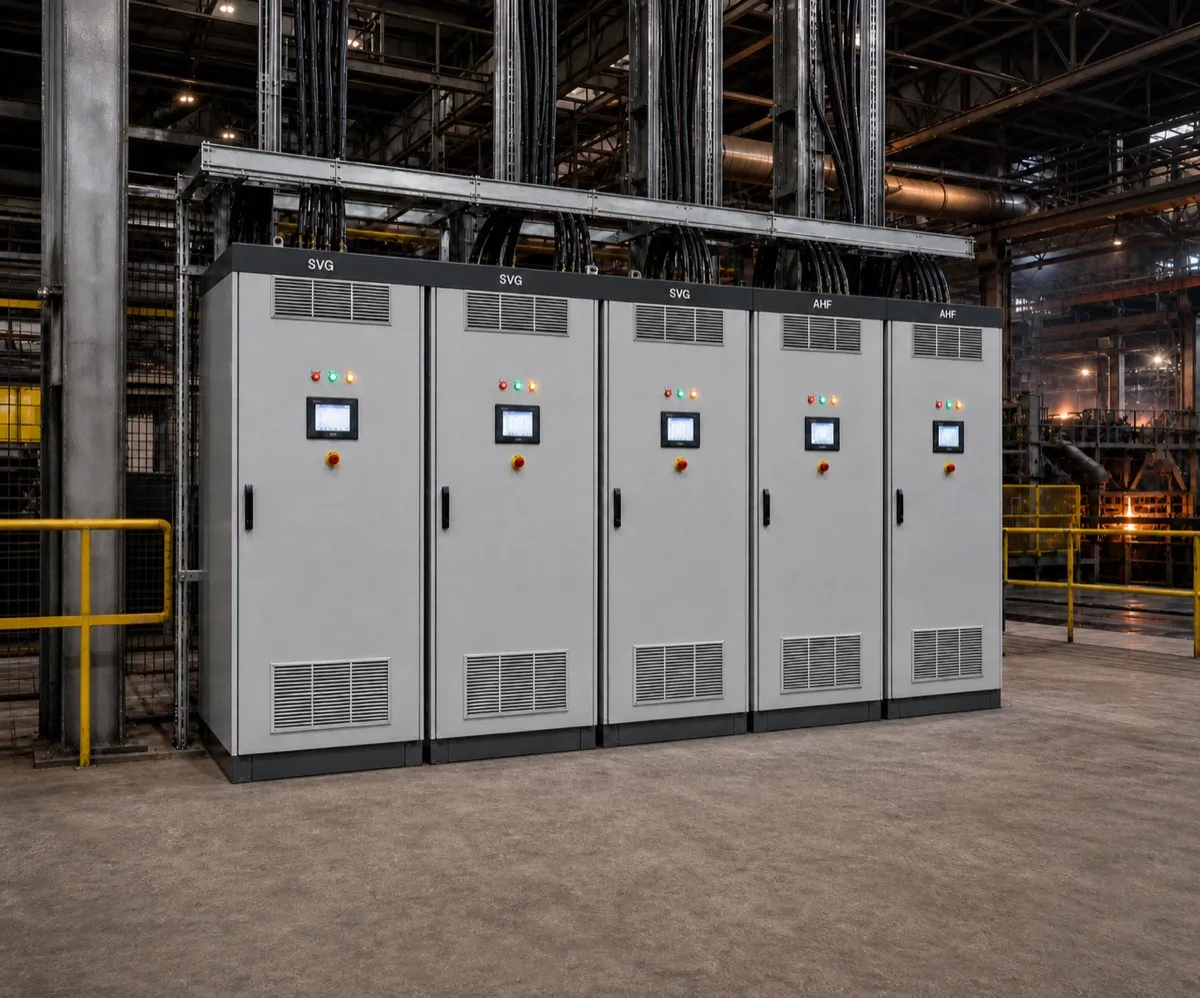
SinaVa Power manufactures equipment for industrial power-quality applications, including Active Harmonic Filters and Static Var Generators. Its published AHF specifications describe compensation up to the 51st harmonic order, while its published SVG material lists a response time below 10 ms for the referenced product family. Final performance depends on model selection, system voltage, installation conditions, control settings, and site characteristics.
For an AI data-center project, SinaVa equipment should be evaluated as part of a site-specific power-quality design. The engineering objective may involve harmonic mitigation, reactive-power compensation, load balancing, voltage support, or a combination of these functions. Active-power buffering should be coordinated with the UPS, energy-storage, generator, and workload-control strategy.
Product information: Sinava Active Harmonic Filter | Sinava Static Var Generator overview | Sinava hybrid compensation overview
Frequently Asked Questions
Do AI data centers always need active harmonic filters?
No. An AHF is appropriate when measurements or a harmonic study show that harmonic current requires mitigation. Some sites may already meet the applicable limits, while others may need passive filtering, low-harmonic equipment, system changes, or a coordinated solution.
What is the difference between an AHF and an SVG?
An AHF primarily compensates harmonic current. An SVG primarily supplies or absorbs reactive power to improve power factor and provide dynamic voltage support. Some equipment can combine functions, but the required capacity and control priorities must be defined from site data.
Can an SVG smooth GPU active-power swings?
An SVG can respond quickly to reactive-power changes, but it does not provide the sustained active energy required to buffer a large real-power step. Active-power smoothing generally requires UPS controls, batteries, flywheels, supercapacitors, workload controls, or another energy source.
Does an AHF guarantee IEEE 519 compliance?
No individual device can guarantee facility-wide compliance without system context. IEEE 519 limits are evaluated at the PCC. Filter selection should follow a study, and compliance should be verified through post-installation measurements.
What information is needed to size a power-quality solution?
Useful inputs include the single-line diagram, system voltage and frequency, transformer data, short-circuit level, capacitor banks, load current, harmonic spectrum, reactive-power profile, unbalance, event records, load ramp rate, and the project target at the PCC.
Conclusion
AI data-center reliability depends on matching each electrical problem with the correct engineering response. AHF systems can mitigate harmonic current, SVG systems can provide dynamic reactive-power compensation, and storage or workload controls can buffer active-power changes. The most defensible design begins with site measurements, applies the correct standard at the correct assessment point, and verifies results after commissioning.
To discuss a site-specific assessment, provide SinaVa Power with the facility single-line diagram, available power-quality measurements, load profile, applicable standard, and performance target.
References
IEA: Key Questions on Energy and AI — Executive Summary (2026)
SinaVa Power: Active Harmonic Filter product page
SinaVa Power: What Is a Static Var Generator?
SinaVa Power: SVG and hybrid compensation overview