Table of Contents
1. Background and Operating Conditions Overview
This case study focuses on a microgrid at a non-neutral oil and gas exploration base on an offshore island . The system operates completely independently from the main power grid (island microgrid), with its core power source being two diesel generator sets connected in parallel (rated total capacity 1200kVA / 960kW ).
This microgrid contains no large power motors, but includes two typical non-electrical, inrush load and nonlinear loads :
Systemic headache before compensation
At the moment when the welding machines were operating concurrently, the microgrid was instantly flooded with an inductive reactive power surge of 450 kVar with a power factor of only 0.35 . Due to the mechanical and electrical transient response lag of more than 200 ms in the diesel generator voltage regulating system (AVR), the system encountered a severe transient voltage sag : the bus voltage dropped instantly from 400V to 310V (a drop of 22.5%), causing the precision measuring instruments at the base to frequently trip due to "low voltage protection," forcing the production line to stop.
2. Core Technology Characteristics Analysis: Why Choose SVG?
For this typical scenario, traditional smart capacitor compensation cabinets (TSCs) are ineffective (TSC switching response is usually >40ms, and is limited by thyristor zero-crossing triggering, making it impossible to catch up with lightning-fast impacts within 100ms, and it is prone to resonance with thyristor loads).
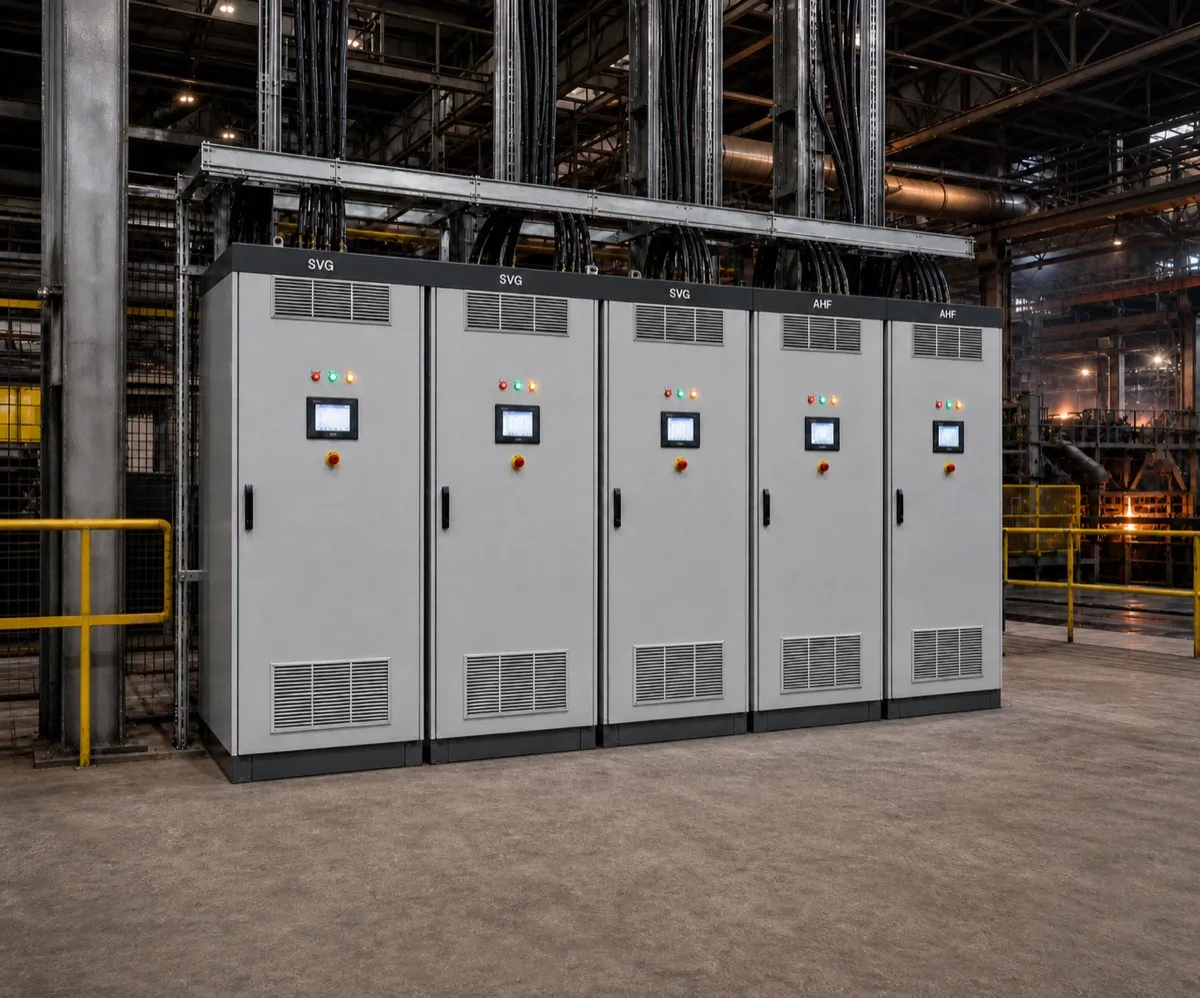
The final solution selected a 500kVar three-level static var generator (SVG) . It possesses the following four core technical characteristics, which are also the most convincing supporting points of this article:
1. Millisecond-level ultra-fast response speed (2ms-level tracking)
SVG adopts a 32-bit high-speed dual DSP + FPGA digital control architecture, and the reactive current detection algorithm adopts the FFT method based on instantaneous reactive power theory .
2. Characteristics of a "voltage-independent" constantly controlled current source
3. Multifunctional integrated management of reactive power and harmonics (SVG)
4. Completely eliminate microgrid system resonance
3. Comparison of Effects Before and After Compensation
To provide the strongest data support for your article, the following is a comparison table of key power quality parameters before and after the introduction of SVG for this microgrid:
| Monitoring parameters | Before Compensation (Diesel Generator) | After Compensation (diesel generator + SVG ) | Improvement effect |
|---|---|---|---|
| Transient BUS voltage drop | It dropped to a low of 310V (-22.5%). | Stable at 388V (-3.0%) | Meets the IEEE Standard Class A power quality requirements |
| BUS power factor (cosphi) | It instantly dropped to 0.35 | Dynamically maintained between 0.98 and 0.99 | Diesel generators basically output no reactive power, and their capacity is fully utilized. |
| Total voltage distortion (THDu) of the system | Up to 8.5% | Reduced to 2.2% | Well below the 5% public grid limit standard |
| Voltage flicker | The light is visibly flickering violently,ΔU=2.5% | Completely eliminate flicker, U=0.45% | Improved online reliability of sensitive measuring instruments |
| Diesel Generator operation status | AVR frequently overheats due to strong excitation, causing abnormal vibration in the unit. | With stable excitation current, unit fuel consumption and temperature rise decreased. | Extend the lifespan of diesel generators and reduce maintenance costs |
4. Conclusions and Industry Implications
This article shown that in microgrids with low inertia and high impedance diesel generators , traditional capacitor bank reactive power compensation equipment is no longer able to cope with non-motor transient inrush current such as modern electronics and high-frequency welding.
With its microsecond-level detection and computing power, current injection speed within 2 milliseconds, and low-voltage-resistant current source characteristics, SVG acts as a "high-frequency reactive power buffer" between the microgrid and the impact load . It successfully disguises a highly destructive "severe impact load" as a "stable, high-power-factor high-quality load" at the electrical level, and is a core technology for ensuring the voltage stability of islanded microgrids.